Inverse Document Frequency (IDF)
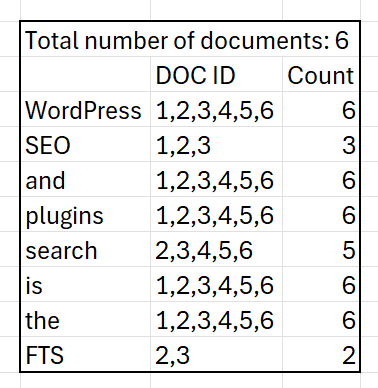
IDF measures how rare or unique a term is across a collection of documents. It's the "inverted" part of TF-IDF (Term Frequency-Inverse Document Frequency).
We can see that for a search query having the query term 'FTS', documents 2 and 3 are highly relevant. If we have a query 'FTS and SEO Plugins', documents 2 and 3 are most relevant, with 1 being behind them and more relevant than the others.
The Core Idea
Common words like "the" or "is" appear in almost every document, so they're not useful for distinguishing between documents.
Rare words like "seo performance" or "Yoast" appear in fewer documents and are more informative.
TF is about 'the document'.
IDF is about 'the documents' - Which one's are more relevant compared to the others.
The Formula
Where:
- N = total number of documents
- df = number of documents containing the term
Example
Say you have 1,000 documents:
- "the" appears in 999 documents → IDF = log(1000/999) ≈ 0.001 (very low)
- "quantum" appears in 10 documents → IDF = log(1000/10) = 2 (higher)
- "riboflavin" appears in 1 document → IDF = log(1000/1) = 3 (highest)
What IDF Tries to Solve
Some words appear in almost every document:
- “the”
- “is”
- “and”
- “of”
If a search engine treated these words as highly important, every document would look similar.
IDF fixes this by down‑weighting common words and up‑weighting rare, meaningful words.
So if a student searches for:
“photosynthesis process”
The word “photosynthesis” should matter far more than “process”.
How IDF Is Calculated
The most common formula is:
IDF(t) = log(N / df_t)
Where:
- N = total number of documents in the corpus
- df_t = number of documents containing term t
- log = logarithm (typically natural log or log base 10)
Key insight: IDF increases for rare terms (low df_t) and decreases for common terms (high df_t).
This smoothing ensures that terms appearing in all documents don't get zero weight and prevents division by zero for edge cases.
Why the log?
Without the logarithm, rare terms would get huge scores.
The log keeps values nicely scaled.
Example
Imagine a collection of 1,000 documents:
| Term | Documents Containing Term ((df_t)) | IDF |
|---|---|---|
| “the” | 980 | log(1000/980) approx 0.009 |
| “photosynthesis” | 12 | log(1000/12) approx 4.42 |
| “chlorophyll” | 5 | log(1000/5) approx 5.30 |
Interpretation:
- “the” → IDF near zero → contributes almost nothing
- “photosynthesis” → high IDF → very informative
- “chlorophyll” → even higher → extremely informative
Why IDF Is Important
1. It filters out noise
Common words don’t help distinguish one document from another.
IDF ensures they don’t dominate search results.
2. It highlights meaningful terms
Rare terms often carry the actual meaning of a query.
IDF boosts these so search engines can rank documents more intelligently.
3. It improves relevance
TF‑IDF (Term Frequency × IDF) combines:
- TF → how often a word appears in a document
- IDF → how rare the word is across the whole collection
Together, they create a balanced score that rewards documents that use important terms frequently.
4. It’s foundational for modern search
Even though we now have embeddings, transformers, and semantic search, IDF still:
- powers classical search engines
- influences hybrid search systems
- appears in ranking models like BM25
Putting It All Together
IDF is essentially a discriminator:
It helps a search engine decide which words actually help identify the right documents.
- Common words → low IDF → low importance
- Rare words → high IDF → high importance
This simple idea dramatically improves search quality and remains a cornerstone of information retrieval.